How AI Agents Are Changing Internal IT Support and Help Desks
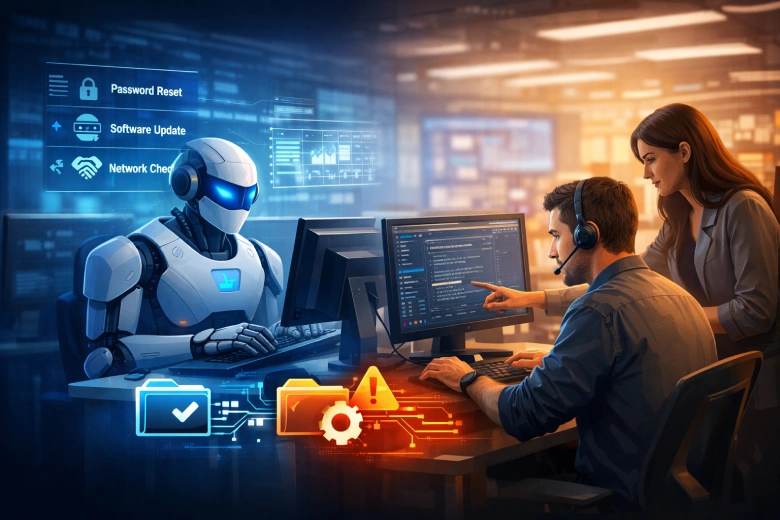
Internal IT support teams face a major shift as AI agents take over tasks that used to require human help desk staff. These smart systems now handle password resets, software issues, and basic network problems without any human input. AI agents reduce ticket volumes and free up IT professionals to focus on complex problems that need human judgment and technical expertise.
This change affects help desk professionals in unexpected ways. Rather than replace human workers entirely, AI creates a new support model where machines handle routine requests and people solve difficult challenges. The technology also helps human agents work faster by finding relevant information and providing context for each issue.
The future of IT support combines AI speed with human problem-solving skills. Organizations that adopt this hybrid approach see faster response times and better service quality. This article explores how AI transforms internal support operations and what it means for help desk teams.
The Impact of AI Agents on Internal IT Support
AI agents now handle routine support tasks independently and deliver faster resolutions across IT help desks. These systems reduce manual workloads, speed up response times, and scale support operations without proportional cost increases.
Automation of Ticketing and Incident Resolution
AI agents transform how organizations process and resolve IT tickets. These systems automatically categorize incoming requests based on content analysis. They identify patterns in user descriptions and route tickets to the appropriate teams without human intervention.
Password resets represent a common use case. An AI agent receives the request, verifies the user's identity through multiple authentication methods, and completes the reset in seconds. Similarly, software installation requests get processed automatically as agents check system compatibility and deploy applications.
The technology also handles incident resolution through multi-step workflows. For example, an employee reports that they cannot access a file server. The AI agent checks network connectivity, verifies user permissions, and tests the server status. If the agent identifies a simple permission issue, it corrects the problem immediately. Complex issues get escalated to human technicians with all diagnostic data already collected.
Organizations that adopt Azumo RAG implementation services can connect their AI agents to internal knowledge bases for more accurate ticket resolutions. This approach allows agents to pull from historical tickets and documentation to solve problems faster.
Enhancing User Experience for Employees
Employees receive instant responses through AI agents instead of waiting in queue. These systems operate 24/7 and provide consistent support quality regardless of time or day. Users interact with agents through familiar channels like Slack, Teams, or email.
The conversational interface feels natural to most users. An employee types "my VPN isn't working" and the agent immediately starts troubleshooting. It asks targeted questions, tests connections, and offers solutions based on the specific error messages it detects.
AI agents also learn from each interaction. They track which solutions work for particular problems and adjust their responses accordingly. This continuous improvement means employees get better support over time without additional training requirements.
Context awareness improves the experience significantly. The agent knows which department the employee works in, what systems they typically access, and what problems others in their role have reported. This information allows for faster diagnosis and more relevant solutions.
Reducing IT Response Times
Traditional IT support often involves wait times of hours or even days for non-critical issues. AI agents cut these delays dramatically by handling requests the moment they arrive. Simple tasks that once took 30 minutes of human time now complete in under a minute.
The speed improvement comes from parallel processing. While human technicians handle one ticket at a time, AI agents manage hundreds simultaneously. This capability proves particularly valuable during high-volume periods like system updates or security patches.
Response time metrics show clear improvements after AI agent deployment. First response times drop from an average of 2-3 hours to under 30 seconds for automated tasks. Resolution times for common issues decrease by 70-80% in many cases.
Technicians also work more efficiently because agents handle the routine questions that previously consumed most of their day. They focus on complex problems that require human judgment and technical expertise. This shift improves both speed and quality across the entire support operation.
Scalability and Cost Savings
AI agents scale support capacity without the linear cost increases that come with hiring more staff. A single agent can handle thousands of interactions per day, far beyond what any human team could manage at the same price point.
The cost structure changes fundamentally. Organizations pay for the technology platform and maintenance rather than per-interaction labor costs. As support volume grows, the per-ticket cost decreases because the same agent infrastructure serves more users.
Small IT teams gain the most immediate benefits. A five-person help desk can support 500 employees just as effectively as 5,000 with proper agent deployment. This efficiency allows companies to grow without proportional increases in support headcount.
Budget savings appear in multiple areas. Direct labor costs decrease as agents handle routine work. Training expenses drop because agents don't require onboarding. Overtime costs disappear as agents provide after-hours coverage at no additional expense. Most organizations report 40-60% reduction in support costs within the first year of implementation.
Transforming the Role of Help Desk Professionals
AI agents are reshaping what help desk professionals do each day, moving them away from repetitive tasks and toward more complex problem-solving work. This shift requires new skills and changes how IT teams operate within organizations.
Shift from Reactive to Proactive IT Operations
Help desk teams traditionally spent most of their time responding to problems after they occurred. Staff members answered tickets about password resets, software glitches, and connectivity issues as they came in. AI agents now handle these routine requests automatically, which frees up professionals to prevent problems before they happen.
The technology identifies patterns in support tickets and system data. For example, AI can detect that multiple users struggle with a specific software update. IT professionals receive this information early and can address the root cause before more employees submit tickets.
This proactive approach reduces the total number of support requests. Help desk professionals now spend time on system monitoring, preventive maintenance, and identifying potential issues. They work with data that AI surfaces to make decisions about infrastructure improvements and user training needs.
Enabling Focus on Strategic Initiatives
AI handles roughly 60-70% of basic support queries without human intervention. This automation allows help desk staff to dedicate time to projects that improve the entire IT environment. They can develop better documentation, create training programs, and work on system upgrades.
Professionals now collaborate more closely with other departments to understand their technology needs. They participate in planning sessions for new software rollouts and contribute insights about common user challenges. The role expands beyond troubleshooting to include consulting and strategic planning.
Staff members also focus on cases that require empathy and complex problem-solving skills. They handle sensitive situations, manage escalated issues, and build relationships with users across the organization. These tasks deliver more value than password resets ever could.
Upskilling IT Staff for AI Integration
Help desk professionals must learn new technical skills to work effectively alongside AI systems. They need to understand how AI tools process requests, interpret suggestions from automated systems, and know the right time to override AI recommendations. Training programs now include AI literacy, data analysis, and advanced troubleshooting methods.
Soft skills become equally important in this new environment. Professionals develop better communication abilities to explain complex technical issues to non-technical users. They practice critical thinking to evaluate AI-generated solutions and decide on the best course of action for unique situations.
Organizations invest in continuous education programs for their IT staff. These programs cover machine learning basics, how to train AI systems with quality data, and ways to improve automated workflows. The goal is to create professionals who can manage both technology and the human aspects of support work.
Conclusion
AI agents have transformed internal IT support from a reactive model to a proactive one. These tools handle routine tasks like password resets and basic troubleshooting while freeing up human teams to focus on complex problems that require creative solutions.
The benefits are clear. Organizations see faster response times, reduced ticket volumes, and better resource allocation across their IT departments.
However, success depends on the right balance between automation and human expertise. AI works best as a support tool that amplifies what IT teams can accomplish rather than a complete replacement for skilled professionals.

How to Build Links Without Losing Sight of Quality







Why HR Teams Should Connect Workforce Planning With Talent Development