How Low Code Platforms Accelerate 3PL Logistics System Integration
Third party logistics providers are companies that use connected technology systems to manage transportation, inventory, warehousing, order fulfillment and customer communication. Integrating these systems is a process that is often slow and requires many technical resources. Low code platforms are tools that allow businesses to build integrations faster with visual development interfaces plus simplified workflows - these platforms are helpful for 3PL providers because they create flexible logistics environments and lower the difficulty of connecting different software.
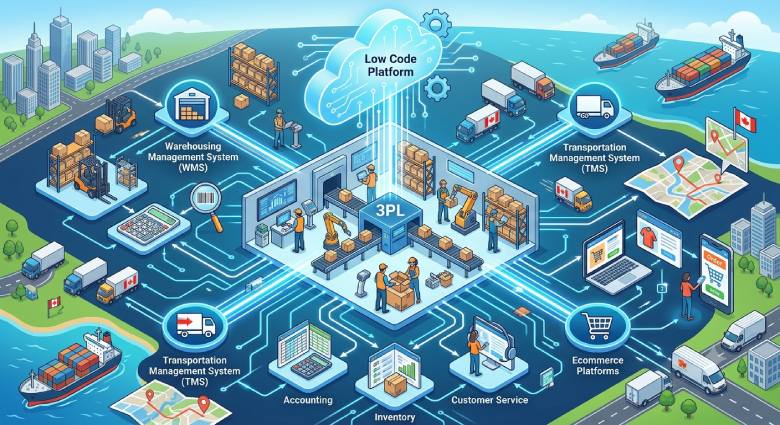
Logistics companies are now using technology that is adaptable to customer expectations and operational demands. Low code solutions are systems that allow teams to connect warehouse management systems, transportation management systems, ecommerce platforms but also enterprise applications. For organizations that work in competitive markets, like companies that support 3PL Canada operations, fast integration is a way to improve responsiveness and service quality.
Simplifying Complex System Connections
Modern 3PL Canada operations are dependent on multiple software platforms that exchange information. A warehouse management system is often required to communicate with shipping platforms, customer portals, accounting tools and inventory databases. Traditional integration methods are characterized by custom coding for each connection, which makes updates expensive. Low code platforms are systems that provide prebuilt connectors as well as configurable integration features.
Logistics teams are able to connect systems without relying on specialized programmers when they use these development environments. Business analysts and operational staff are participants in integration projects because they can complete changes through visual interfaces - this approach is a way to lower communication gaps between technical teams and logistics professionals while helping companies deploy improvements quickly.
Improving Implementation Speed
Speed is a primary feature of low code platforms for logistics system integration. Supply chain businesses are often required to adjust their technology when customer requirements, shipping volumes or operational processes change. Traditional development projects are long and can prevent companies from responding to new opportunities. Low code solutions are tools that shorten development cycles - allowing teams to create workflows with few manual programming requirements.
Fast implementation is also a way for logistics providers to introduce new services. As an example, a 3PL company that adds an ecommerce partner is able to create automated data exchanges without changing its entire technology infrastructure - this flexibility is a method for businesses to scale their operations while maintaining communication between systems.
Enhancing Data Accuracy Across Systems
Accurate data movement is a requirement for logistics operations. When systems are disconnected, companies are prone to inventory errors, delayed shipments or incorrect customer information. Low code integration platforms are tools that automate data transfers between applications to ensure that information is consistent across the supply chain.
Automated workflows are a way to keep different departments aligned with the same information. Warehouse teams, transportation managers and customer service representatives are able to access updated data without waiting for manual reports. Data accuracy is a support for decision making next to helps logistics providers maintain reliable service levels.
Supporting Greater Operational Flexibility
Supply chains are changing because of customer expectations, new delivery models and the demand for real time information. Logistics companies are in need of systems that are adjustable. Low code platforms are flexible because they allow businesses to modify processes, add integrations and create new automation workflows when operational needs change.
3PL providers that serve multiple industries find this flexibility useful. A logistics company is often required to use customized workflows for retail clients, manufacturing customers or ecommerce businesses. Low code tools are a way to adapt system connections for different customer needs while internal processes remain consistent.
Reducing Technology Development Costs
Custom integrations are projects that require financial investment. Businesses are often required to provide resources for software developers, maintenance, testing plus system updates. Low code platforms are a way to lower the expenses - minimizing the amount of custom programming required for integration tasks.
Lower development costs are a way for logistics companies to invest in other areas, like automation, employee training or customer service. Instead of maintaining complex integrations, technology teams are able to focus on projects that improve business performance.
Strengthening Collaboration Between Teams
Logistics technology projects are successful when operational teams and technical departments cooperate. Communication challenges are common in many organizations and can slow down system improvements. Low code platforms are shared environments where both groups are able to design workflows but also improve processes.
This collaborative approach is a way to ensure that integrations meet operational needs. Logistics employees are knowledgeable about daily challenges, while technical teams are responsible for system capabilities and security - these groups are able to develop solutions that are efficient and practical for daily use.
Improving Future Scalability
Technology requirements are more complex as logistics companies grow. New warehouses, additional transportation partners as well as expanding customer networks are factors that increase the demand for connected systems. Low code platforms are tools for scalability because they make it easy to add new applications and expand workflows.
A scalable integration approach is a way for 3PL providers to remain competitive. Companies are able to respond to growth opportunities because their technology infrastructure is designed for expansion - this is a foundation for long term digital improvement and operational growth.
Conclusion
Low code platforms are tools that accelerate 3PL logistics system integration - simplifying development or improving data accuracy - these solutions are a way for logistics providers to connect complex systems while creating adaptable technology environments. As supply chains become more digital, businesses that use flexible integration strategies are better able to improve efficiency and meet customer expectations.

How to Build Links Without Losing Sight of Quality







Why HR Teams Should Connect Workforce Planning With Talent Development