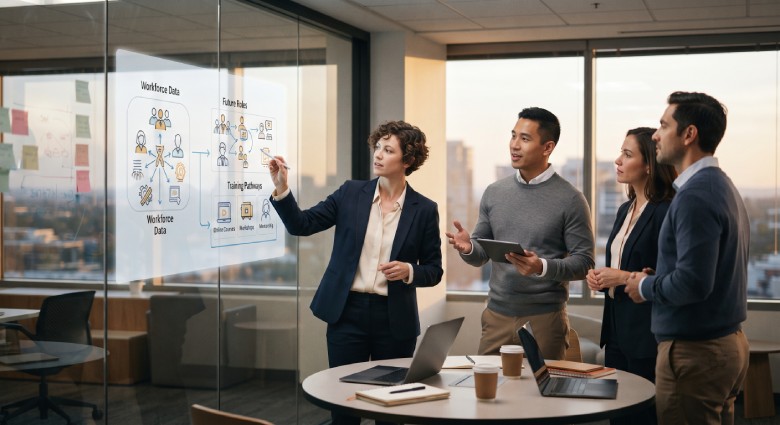
Why HR Teams Should Connect Workforce Planning With Talent Development
Workforce planning is a method for employers to understand the specific skills and numbers of staff members they require as business needs evolve. Talent development is the process of preparing staff members for those needs through education and career advancement. Organizations that manage these tasks separately often identify future staffing needs without a functional method to train the staff members who could meet those needs. Coordinating workforce planning with talent development is a more organized way for Human Resources (HR) departments to prepare staff members for shifting organizational goals.
Align Development With Future Needs
Information from workforce planning is useful for HR departments to identify which roles and abilities an employer will require in the future. HR professionals are able to identify skills that are likely to increase in importance instead of training staff members only for their current tasks - this method is a way to link the growth of staff members to the long term goals of the employer.
If an employer intends to use new technology, for example, certain teams will likely require more technical skills. HR departments are able to use planning data to select specific staff members who are suitable for training - this strategy ensures that learning activities are a way to support expected staffing needs rather than responding only to immediate requests.
Identify Skills Gaps
Skills gaps are easier to see when HR departments link these two processes. Workforce planning is a way to show where an employer lacks enough staff, while talent development is a way to decide if current staff members are able to learn the skills necessary to fill the holes - this provides HR departments with more data when they consider future hiring.
Analysis of the gaps is also a way to differentiate between various staffing problems. Some gaps are a reason for external hiring because the specific expertise is not available among current staff members. Other gaps are solvable through training - this distinction is a way for HR departments to plan learning activities with a specific purpose.
Strengthen Internal Talent
Talent development is an organized method for employers to prepare staff members for future duties. HR departments are able to check if current staff members have the capacity to move into important roles when planning data identifies those positions. Development plans are then able to focus on the growth of specific knowledge and experience.
Staff members receive clearer career paths through this process. Staff members are able to make better choices about their own growth when they know which skills are valuable for future roles. Managers are able to assist - finding projects or training that allow staff members to gain experience.
Improve Succession Planning
Succession planning is stronger when workforce planning and talent development are used together. Employers must know which positions are likely to need new occupants and if internal candidates are available. Workforce planning is a way to find areas of risk, while talent development is a way to prepare staff members for those future duties.
Planning is more effective when training starts before a position is empty. Candidates who are suitable for roles are able to receive education and experience over a long period - this is a more organized way to prepare for leadership and other vital positions.
Support Employee Retention
Staff members are often more productive and loyal when they see paths for advancement and skill growth. HR departments are able to create training that matches both the interests of the staff members and the future needs of the employer - this is possible - linking talent development with workforce planning.
Growth opportunities are also an alternative for staff members who might otherwise leave because their current tasks are no longer challenging. Internal mobility and new responsibilities are ways for staff members to learn new abilities while staying with the employer. HR departments use planning data to find where these opportunities are most necessary.
Improve Training Decisions
Employers spend significant money on training - it is important that these activities support actual staffing needs. Workforce planning is a way for HR departments to see which skills are becoming more important. They use this data to build training programs.
HRIS software is a tool to assist this process - collecting data about staff members in one place. HR departments are often able to see roles, skills and growth data in a single system. Centralized data is a way to make it easier to connect training plans to broader staffing goals.
Improve Resource Allocation
Coordinating the processes is a way for employers to decide where to spend their training budget. Not every role has the same level of future importance - HR departments need a logical way to choose which initiatives are the most important. Planning data is the context for these choices.
Wasteful training is less likely with this strategy - HR departments focus on skills that solve known problems rather than offering programs without a clear reason. Staff members are still able to learn broadly but specific data helps the employer decide where a financial investment is most relevant.
Prepare for Organizational Change
Changes in business affect the skills and roles an employer requires. New technology or changes in what customers want are all reasons for new staffing needs. Linking planning with development is a way for HR departments to help staff members prepare for these shifts.
Preparation before a major change occurs is a way to lower the stress of new duties. Training programs are able to introduce skills slowly so that staff members have time to learn. Workforce planning is the source of the data needed to decide where this preparation is necessary.
Strengthen Manager Participation
Managers are important in this process because they understand the daily tasks of their teams. HR departments work with managers to find skills that staff members need now and abilities that are likely to be important later - this provides a more accurate view of what the staff needs to learn.
Managers also help staff members use their new skills - Staff members need chances to apply what they learn in their daily work. Managers provide the projects and feedback that make training a functional part of the employer's future capabilities.
Create Continuous Planning
Staffing needs change frequently - the link between planning and development requires regular review. HR departments are able to compare future goals with current skills and training progress - this is a way to change development plans when priorities shift.
A constant approach ensures that talent development is not just a single yearly event. Development is instead a part of regular business discussions. Frequent reviews are a way for HR departments and managers to find new needs and keep staff skills aligned with employer goals.
Conclusion
Coordinating workforce planning with talent development is a way for HR departments to handle future needs for both the employer and the staff members. Planning shows where skills are necessary, while development is the way to prepare current staff members for the roles. The methods are a way to support hiring, retention and business changes while providing staff members with opportunities to grow.





Why HR Teams Should Connect Workforce Planning With Talent Development
Weltrade Broker Review: Examining Its Tools and Trading Environment
How HCS 411GITS Software Is Built: The Complete Development Process