How To Speed Up Delivery Times Using Local Micro-Fulfillment Centers
With the growth of on-demand and rapid delivery services, companies now more than ever face pressure to shorten the amount of time their products take to be delivered to their respective customers. The traditional fulfillment models based on centralized distribution warehouses cannot keep up with the current pace of delivery in urban environments with congested roads or in areas that are distant to the major distribution centers. Local micro-fulfillment centers are becoming an increasingly popular solution among companies that want to remain competitive and achieve customer satisfaction rates.
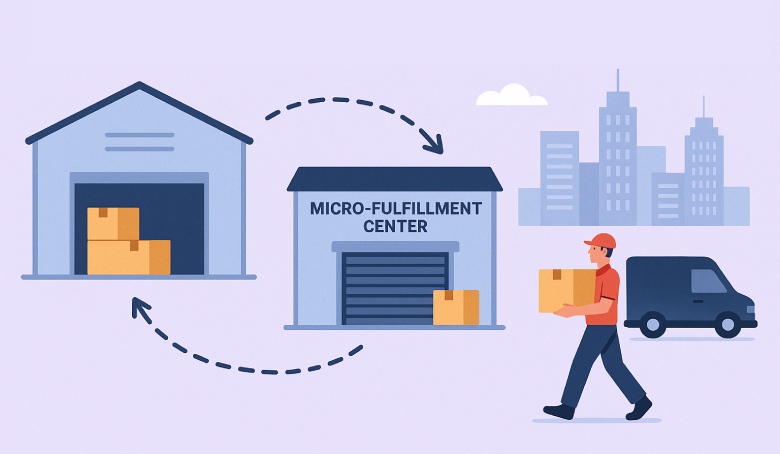
Micro-fulfillment centers are more locally based, smaller centers meant to store and distribute inventory closer to the final customer. Their greatest strength is the fact that they are located closer to the urban areas or areas with high demand for their products hence their ability to fulfill and deliver orders faster. With companies dedicating themselves more visibly to speed and efficiency, micro-fulfillment centers have taken a place in last-mile delivery strategies as a key to balancing the acceleration of e-commerce with customer service levels.
Facility Location Close To The Customers.
Identifying the right locations is one of the fundamental concepts of an effective micro-fulfillment strategy. The facilities are usually located in or around the densely populated places where the online orders are already high. With inventory placed nearer to the place of demand, business establishments can cut down delivery distances/time exponentially. Such closeness not only serves the customer well, it also reduces transport expenses as well as enhances responsiveness of logistics.
In choosing the locations of micro-fulfillment centers, companies use client information and delivery patterns to determine the best places. This involves analysis of order density, population demographics and proximity to major roads or transit centres. The better a company can anticipate demand hot spots, the better it can deploy micro-fulfillment to fulfill them fast and at minimum cost.
Minimising Last-Mile Delivery Delays
The last leg of the shipping journey, sometimes known as the last mile, is usually the most costly and longest phase of fulfillment. Late delivery in this segment is normal because of such reasons as road congestion, inefficiency of the route, and missed deliveries. Micro-fulfillment centers drastically change this factor in favor by making the inventory close to the customer (within a short distance), making same-day or next-day delivery possible with less complexity involved.
The reduced distances between stock and consumers also make it possible to be more flexible and certain about delivery planning. The companies will be able to provide smaller delivery windows and even delivery on demand services. Speed and accuracy in serving the customers will help enhance their satisfaction, lower returns rates and boost loyalty.
Allowing Quicker Order Processing
Micro-fulfillment centers are more than a matter of location; they also have systems in place to handle orders quickly. These centers frequently depend on automation, conveyors, as well as committed packing centers that ease the picking as well as packing procedure. The sophisticated layout design creates enough room even in small areas whereby staff members can pick a large number of orders quickly.
Micro-fulfillment centers are able to be more speedy and nimble than their larger counterparts due to their dedicated inventory and smaller footprint. Online orders can be directly sent to the nearest center and they are picked, packed and dispatched in a limited period. Such speed comes in particularly during peak seasons when fulfillment centers have to process an increased number of orders without having to slow down.
Facilitating A Multi-Node Fulfillment Paradigm
The ability to use several micro-fulfillment centers enables businesses to spread their inventory across nodes in their supply chain. Such a multi-node model will lessen reliance on one distribution hub and provide more flexibility in case of disruptions. To take an example, should one site be hit by the weather or transport problems another nearby center can intervene to take the overflow and hold delivery times.
This model makes the allocation of inventory more strategic. This allows the business to stock the correct products at correct locations by studying the purchase behavior and demand of products in that particular region. This does not only enhance the speed of delivery but also minimizes cases of stockouts and excessive products. To get the products to and fro these centers, route optimization software is important in ensuring that the routes are optimized to balance inventory, and to prevent excess losses due to avoidable delays.
Optimizing Delivery Fleet
Micro-fulfillment centers network allows using local delivery fleets more efficiently. Since the radius that each center covers is smaller, the routes that have to be made to deliver products are shorter and more predictable and manageable. Drivers are in a position to do more deliveries within a day without covering long routes thus saving on fuel and vehicle maintenance.
Route optimizing software improves fleet performance, taking into consideration traffic trends, delivery times, and geographic limitations. They are used to determine the most optimal routes that a delivery driver can take to ensure that the orders have the shortest possible time of delivery. By reducing the number of miles to be covered and by making smarter routing, businesses are able to provide faster delivery without really expanding their operation cost.
Improvement Of Customer Experience
The expectations of customers have shifted towards speed, reliability and transparency. Micro-fulfillment centers assist companies in fulfilling these expectations, as they enable delivering goods quickly to become a default option and not a paid upgrade. Customers are sent their orders within a short time, usually hours and they have access to real time tracking information that keeps them posted on the progress.
Faster delivery capability also paves the way to value-added services, including reserved time slots, delivery at the weekend, and hassle-free returns. Such comforts are achieved through the enhanced logistics performance that micro-fulfillment makes viable. Once customers start relating a brand with fast and constant delivery, it boosts their confidence and chances of making repeat purchases.
Lessening Environmental Harm
Reduced distances in delivery not only decreases the delivery time but also decreases the carbon footprint of the individual delivery. Local inventory and optimized delivery routes reduce the amount of miles driven and fuel used by business. This helps towards sustainability efforts and attracts more environmentally conscious consumers who look at shipping practices as a part of brand selection.
Besides, micro-fulfillment centers can deliver to smaller delivery areas with low-emission vehicles or bicycles, or even walking couriers in some cities. Such green last-mile delivery solutions become more practical when fulfillment centers are integrated into neighborhoods instead of being situated distant in relation to the aggregations of customers.
Reducing Environmental Impact
The decreased distances in delivery not only expedite the delivery times but also minimize the carbon footprint of the individual delivery. Local inventory and efficient delivery routes reduce the number of miles driven and fuel that is used. This is towards sustainability and attracts environmentally sensitive customers who use shipping practices as a brand choice factor.
Moreover, small delivery areas that are facilitated by micro-fulfillment centers can be fulfilled with low-emission vehicles or even bikes and on-foot couriers in certain urban environments. Such eco-friendly last-mile delivery solutions become more practical when fulfillment centers are integrated into communities instead of being situated distant away from customer concentrations.
Preparing For Future Logistics Trends
Due to the growth of e-commerce, the need to move towards quick and efficient delivery is going to grow. The companies that will invest in local micro-fulfillment centers are planning to confront this future demand directly. This model allows flexibility and responsiveness that is a competitive advantage in a market that convenience and speed are major differentiators.
To support these fulfillment networks, future logistics strategies will probably place additional trust in data-driven decision making, robotics, and technologies such as route optimization software. The companies that develop the infrastructure now will be more likely to adjust to the shifting consumer habits and delivery demands. Adopting micro-fulfillment today is a move towards being ahead in the continually accelerating retail and delivery world.


5 Best Data Recovery Software Tools to Recover Deleted or Lost Files

What Is Utility Software? 18 Examples of Utility Software Tools