10 Key Benefits Of Network On Chip In Modern Chip Design
How does a modern chip move data so fast between many small blocks inside it?
This is a common question when people hear about advanced chip design. Today’s chips are not just one simple circuit. They have many parts like processor cores, memory blocks, controllers, sensors, and special units for tasks like graphics, signal work, and data handling.
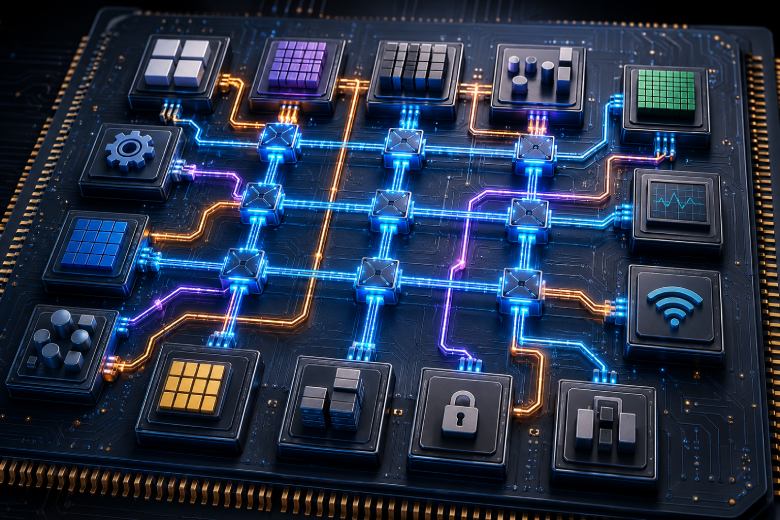
All these parts need to talk to each other in a clean and smart way. That is where the network on chip becomes important. It works like an internal road system inside a chip, helping data move from one part to another in an organized manner.
Better Data Movement Inside The Chip
Modern chips handle many tasks at the same time, so data movement must be smooth and well planned. A good on-chip communication method helps each block send and receive data with proper timing.
Faster Communication Between Blocks
One key benefit of a network on chip is faster communication between different parts of the chip. Instead of using one shared path for many blocks, it allows data to move through planned routes. Think of it like city roads.
When roads are well-connected, people reach their destination faster. In the same way, chip blocks can share data quickly when the internal communication system is arranged well.
This helps in tasks where many blocks are working together. For example, one part may collect data, another part may process it, and another part may store it. With a network on a chip, all these steps can happen in a more balanced way.
Easy Support For Multi-Core Chips
Many modern chips use more than one core because this helps them manage many tasks together. A strong communication structure helps these cores work as a team.
Smooth Core-To-Core Connection
In a multi-core chip, each core may need to share data with other cores. NoC interconnect gives a clear path for this sharing. It helps cores talk to each other in an ordered way. This is useful in processors used for mobile devices, smart devices, AI systems, and many other digital products.
In simple words, when many people are working in one office, they need a proper way to pass messages. If the message flow is clear, work gets done faster. The same logic applies inside a chip.
Better Scalability For Bigger Chip Designs
As chip designs grow, the communication system must grow with them. Network on chip helps designers add more blocks without making the internal structure hard to manage.
Helpful For Large System-On-Chip Designs
A system-on-chip may include many functional blocks in one chip. When more blocks are added, the chip needs a better way to connect them. Network on chip cleanly supports this growth. Designers can add new cores, memory units, and controllers while keeping communication well arranged.
This is a practical benefit because chip needs can change based on use. Some chips may need more processing units. Some may need more memory access. A flexible structure makes this easier to plan.
Better Use Of Chip Resources
Chip space is valuable, and every part must be used wisely. A well-planned communication system helps make better use of available resources.
Smart Sharing Of Internal Paths
With a network on a chip, data paths are used in a more organized manner. Different blocks can send data through suitable routes instead of depending on one common connection. This helps the chip manage traffic in a more balanced way.
A simple example is a busy road with many lanes. If vehicles can take different lanes based on direction, movement becomes better. In a chip, data packets also move more nicely when paths are planned properly.
Higher Performance For Modern Applications
Today’s applications need quick processing and quick data access. Network on chip supports this by improving how chip blocks exchange data.
Good Support For Data-Heavy Tasks
Many modern tasks involve large data flow. These may include image processing, video handling, machine learning, communication systems, and storage control. NoC interconnect supports such tasks by allowing many data transfers to happen in a structured way.
This helps the chip keep up with demanding work. When data reaches the right block at the right time, the full system can perform better.
Better Energy Use In Chip Communication
Energy use is a major part of chip design. A good internal network can help manage communication in a more efficient way.
Cleaner Data Routing For Efficient Operation
Network on chip can help data take suitable routes inside the chip. When communication is arranged properly, the chip can manage its internal activity in a more controlled way. This supports better energy handling during regular work.
For battery-based devices, this is very useful. Even small improvements in internal communication can support longer and steadier device use.
Easier Design Management
Modern chip design includes many teams, many blocks, and many technical choices. A clear communication method makes the full design easier to manage.
Modular Structure For Simple Planning
Network on chip supports a modular style. This means chip blocks can be planned like separate sections that connect through a common communication method.
Designers can focus on one block at a time and then connect it to the full chip system. This is like building a house room by room, while keeping the main wiring and water lines planned from the start. It makes the full work more organized.
Better Reliability In Data Transfer
Data inside a chip must move correctly and steadily. A structured internal network helps maintain clean communication between blocks.
Organized Packet-Based Communication
In many network-on-chip systems, data moves in small units called packets. These packets carry information about where they need to go. This makes internal communication more controlled and easier to handle.
This style is similar to sending a parcel with an address. The parcel knows its destination. In the chip, data packets also move in a direction, which helps the chip manage communication neatly.
Strong Support For Different Chip Functions
Modern chips are made for many different jobs. Some focus on computing, some on communication, some on graphics, and some on smart control. A network on a chip can support different types of blocks in one layout.
Useful For Mixed Function Chips
A chip may include processor cores, memory units, input-output blocks, and accelerators. These blocks may all have different communication needs.
Network on chip helps connect them in a common structure. This gives designers more freedom in planning how each block should talk to others. It also helps the chip support many tasks in one compact design.
Better Future Readiness
Chip design keeps moving toward more cores, more functions, and more data movement. Network on chip is a good fit for this direction because it supports growth and structured communication.
Ready For Advanced Chip Needs
As devices become smarter, chips need to handle more work in less space. NoC interconnect supports this need by giving a strong base for internal communication. It helps future chip designs manage more processing blocks and more data flow practically. For users, this means better digital products. For designers, it means a clear method to build chips that can match modern requirements.
Conclusion
Network on chip is an important idea in modern chip design because it helps data move clearly, quickly, and efficiently inside complex chips. It supports multi-core layouts, better performance, smart resource use, and easier design planning.
In simple words, it gives the chip a good internal communication system, just like a well-planned road network in a busy city.
As chips continue to include more functions, network on chip and NoC interconnect will keep playing an important role in making internal communication more organized and ready for advanced digital needs.

How to Build Links Without Losing Sight of Quality








Why HR Teams Should Connect Workforce Planning With Talent Development