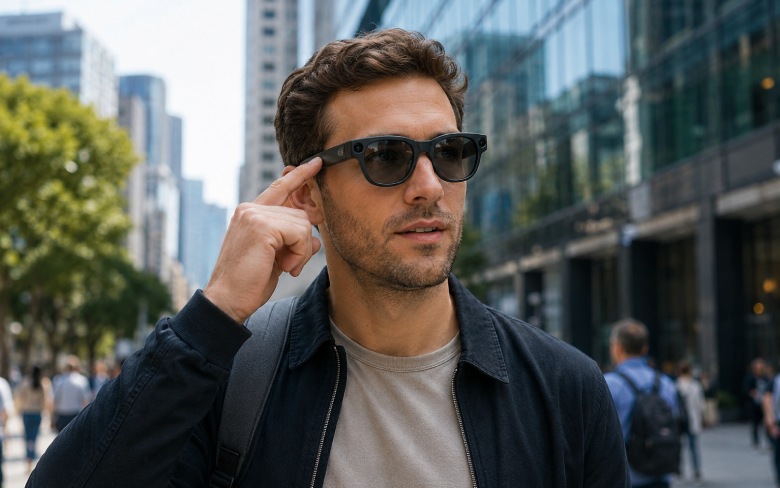
Why AI Glasses Are Attracting Attention From Tech Companies
Technology companies have spent decades searching for the next major computing interface. Desktop computers put software on desks, smartphones moved computing into pockets, and smartwatches brought selected digital functions to the wrist. Now, AI-powered eyewear is receiving growing attention because it offers something those devices cannot provide in quite the same way: access to digital assistance while users remain engaged with the physical world around them.
The interest goes well beyond putting a camera or voice assistant into a pair of frames. AI glasses bring together several major technology trends, including generative AI, computer vision, voice interfaces, wearable computing, cloud services, and increasingly compact hardware. For technology companies, that combination creates opportunities in hardware, software, advertising, commerce, productivity, content creation, and entirely new types of user interaction.
AI Glasses Could Become a New Computing Interface
Smartphones transformed technology partly because they became an interface for thousands of services rather than remaining simple communication devices. Maps, payments, photography, messaging, entertainment, work tools, and shopping eventually converged on the same portable platform.
AI glasses could develop along a similar path, although their role is likely to be different. Instead of asking users to look down at a screen, eyewear can potentially support brief interactions while people continue walking, working, talking, traveling, or experiencing an event. Voice, audio, cameras, and AI can provide information without requiring a traditional display for every task.
That difference matters to technology companies because new interfaces often create new software categories. When smartphones became mainstream, they created enormous markets for mobile applications, location-based services, ride sharing, mobile advertising, social platforms, and app-based commerce. Companies are now watching smart eyewear to understand whether it could create a comparable, even if smaller, ecosystem around hands-free computing.
Artificial Intelligence Makes Smart Glasses More Practical
Smart eyewear is not a completely new idea. Previous generations often struggled to establish a strong consumer use case because the technology could feel complicated, conspicuous, or too limited relative to a smartphone. Artificial intelligence changes the equation by giving wearable devices more useful ways to interpret voice, images, and context.
A user does not necessarily need to navigate through a menu if they can describe what they want conversationally. Visual AI can potentially help software understand information captured by a camera, while speech recognition and language models can make voice commands more flexible than traditional keyword-based assistants.
This means the value of smart eyewear increasingly comes from the relationship between hardware and software. A camera alone is familiar technology, and a microphone alone is not especially novel. Combining those sensors with AI that can interpret context and return useful information creates a more compelling platform for technology companies to explore.
The Market Is Moving Beyond Early Experiments
Interest in smart eyewear is also being supported by changes in hardware design and consumer expectations. Components have become smaller, AI capabilities have improved, and technology companies have learned important lessons from earlier wearable products about comfort, battery life, privacy, and appearance.
McKinsey's State of Fashion 2026 identified smart frames as one of the important consumer shifts shaping the year, highlighting the combination of multimodal AI, improving hardware, and fashion-oriented design. That intersection is important because glasses are different from most consumer electronics: people wear them directly on their faces, which means appearance can matter almost as much as technical capability.
For technology companies, this expands the competitive landscape. Smart eyewear is not simply an engineering problem. Companies need to think about industrial design, fashion partnerships, retail distribution, optical expertise, and consumer trust alongside software and AI development.
Familiar Design Can Lower the Barrier to Adoption
One reason tech companies are interested in glasses is that the form factor is already familiar. Millions of people wear prescription eyewear or sunglasses every day, so the basic behavior of putting on a pair of glasses does not need to be taught.
This gives smart eyewear an advantage over entirely new device categories that ask consumers to carry or wear something unfamiliar. Products such as Ray-Ban Meta eyeglasses reflect an approach where technology is incorporated into recognizable eyewear rather than requiring the product to look primarily like a piece of electronics.
That design philosophy may be important for broader adoption. Consumers frequently choose accessories based on style, comfort, brand familiarity, and fit, while technology companies traditionally compete on specifications and features. AI eyewear forces those priorities to meet, which is why partnerships between technology and established consumer brands can become particularly valuable.
Voice Interaction Reduces Dependence on Screens
Voice interfaces have existed for years, but wearable devices give them a different purpose. On a phone, voice is one of several ways to perform an action. On smart glasses, it can become one of the primary ways to interact because the user may not have a conventional screen or keyboard available.
That makes improvements in speech recognition and conversational AI especially important. A wearable interface becomes much more useful when users can ask natural questions rather than memorize exact commands. Short actions such as capturing content, requesting information, controlling audio, or creating reminders can happen without interrupting another activity.
Technology companies see potential here because reducing screen dependence could change where and when people interact with digital services. Instead of competing only for time spent looking at an app, companies could create services that remain available while users move through everyday environments.
Cameras Create a New Layer of Context
Smartphones already contain powerful cameras, but people must intentionally take them out and point them at something. Glasses provide a first-person perspective that can make visual input available with much less effort.
For AI systems, visual context can be valuable because a spoken question often makes more sense when the system can understand what the user is referring to. This creates opportunities for computer vision, object recognition, translation, accessibility, navigation, education, and professional applications.
The important point for technology companies is that AI can move from responding only to text prompts toward understanding a combination of voice and visual information. That multimodal interaction is one of the reasons eyewear is receiving attention as a potential AI interface rather than simply another wearable accessory.
Content Creation Is an Immediate Consumer Use Case
One of the clearest applications for smart glasses is hands-free photography and video. Smartphones made everyone a potential content creator, but capturing a moment still requires holding a device, framing the scene, and often stepping partly outside the experience.
Glasses can capture content from the wearer's perspective while leaving both hands free. That can be useful for travel, sports, events, demonstrations, tutorials, family activities, and behind-the-scenes material. The footage can also feed into existing editing, social media, and cloud-storage workflows.
For technology companies, this creates opportunities beyond selling the hardware. Media processing, automatic editing, transcription, content organization, storage, recommendation systems, and creator tools can all become part of the surrounding software ecosystem. A successful wearable category could therefore generate demand across several existing technology markets.
Smart Eyewear Could Expand the App Economy
Every major device platform creates demand for software that makes the hardware more useful. If smart eyewear adoption continues to grow, developers may look for ways to adapt productivity, travel, messaging, fitness, navigation, education, and business applications for wearable interaction.
The experience will not simply involve shrinking smartphone applications. Smart glasses favor shorter, context-aware interactions. A user may want a quick answer, an audio notification, a short navigation instruction, or the ability to trigger an action without navigating through several menus.
That creates room for new user experience patterns and specialized applications. Technology companies that already operate major app ecosystems have a reason to explore smart eyewear early because the companies that define developer tools, APIs, permissions, and interface standards can influence how the broader ecosystem develops.
Enterprise Applications Could Be Just as Important as Consumer Uses
Consumer products receive much of the attention, but businesses may also find practical uses for AI eyewear. Employees in field service, logistics, construction, manufacturing, healthcare administration, hospitality, retail, and other industries often need access to information while their hands are occupied.
Smart glasses could potentially provide instructions, communication, documentation, or contextual information without requiring workers to repeatedly stop and look at another device. AI could also help organize voice notes, retrieve knowledge-base information, or connect employees with existing enterprise systems.
Technology companies already selling cloud platforms, enterprise software, productivity tools, or device-management systems can see a natural extension into this environment. If wearable devices become common in workplaces, businesses will need applications, security controls, deployment tools, analytics, integrations, and technical support around them.
AI Glasses Create Opportunities for Cloud Providers
Although some AI processing can happen on-device, compact wearables cannot perform every computationally demanding task locally. Advanced language models, visual analysis, media processing, and large-scale personalization can depend on cloud infrastructure.
This makes AI eyewear relevant to cloud providers as well as hardware companies. Every request processed remotely can require compute capacity, secure data transmission, APIs, storage, identity services, and monitoring. The more capable wearable applications become, the larger the supporting cloud ecosystem may need to be.
At the same time, companies have to balance cloud capability with latency, cost, and privacy. Not every interaction should require sending large amounts of information to a server. The most effective products will likely use a combination of on-device processing and cloud AI depending on the task.
The Device Could Become a Commerce Interface
Technology companies are also interested in any platform that could influence how consumers discover products and services. Smartphones created mobile commerce, app stores, location-based advertising, digital wallets, and social shopping. Wearable AI could introduce new forms of product discovery that are more conversational and context-aware.
A user might ask for information about something they encounter while traveling, receive a recommendation based on their current situation, or request information without opening a shopping application. The commercial potential is significant, but the experience will need careful design because overly aggressive advertising could quickly make a wearable device frustrating.
The strongest commerce experiences will likely prioritize usefulness. Contextual recommendations, navigation to nearby services, hands-free shopping assistance, and easy access to product information could feel natural when initiated by the user. Technology companies will have to find a balance between monetization and preserving trust.
Wearable AI Creates New Data and Privacy Questions
The features that make AI glasses interesting also create some of their biggest challenges. Cameras, microphones, location information, voice interactions, and personal accounts can generate sensitive data, particularly when devices are used throughout the day.
Technology companies know that consumer trust can determine whether a new device category succeeds. Clear recording indicators, understandable privacy controls, secure data handling, and responsible default settings will therefore be essential. Businesses also need to think about the privacy of people around the wearer, not only the person who owns the device.
These concerns do not automatically prevent adoption, but they raise the standard for product design. Companies that treat privacy as part of the core experience rather than an afterthought will be better positioned to build long-term trust around wearable AI.
Battery Life Remains a Significant Engineering Challenge
AI processing, cameras, wireless connectivity, audio, and sensors all consume energy, yet glasses cannot accommodate batteries as large as those inside phones or laptops. The product also has to remain comfortable enough to wear for extended periods.
This forces technology companies to optimize hardware and software together. Certain operations may need to run only when requested, while others can be shifted to a connected phone or cloud service. Efficient chips, optimized AI models, intelligent power management, and careful background processing can all influence how useful the device feels in everyday life.
Battery limitations also encourage developers to prioritize meaningful features. Wearable products cannot simply run every possible service continuously, so software needs to understand when additional processing genuinely provides value.
Competition Is About Ecosystems, Not Just Devices
The long-term competition around AI glasses may not be determined solely by which company produces the best frame. Consumers will also care about how easily the product connects with their existing digital lives.
Messaging, photos, music, navigation, AI assistants, cloud storage, productivity tools, mobile devices, and third-party applications can all contribute to the experience. A technically impressive device may struggle if it operates inside a limited ecosystem, while strong integrations can make a less dramatic feature set much more useful.
This is familiar territory for major technology companies. Smartphones, smartwatches, speakers, and tablets became more valuable as parts of connected ecosystems. Smart glasses could become another point of interaction within those networks rather than functioning as isolated products.
Fashion Gives Technology Companies a Different Challenge
Most technology products can prioritize engineering and then design an attractive enclosure around the hardware. Eyewear works differently because the product sits prominently on a person's face and becomes part of their appearance.
That means frame shape, weight, materials, color, comfort, and brand identity are central to adoption. Someone may admire the technology but still refuse to wear the product if it does not fit their personal style.
This explains why established eyewear expertise can matter as much as technical capability. AI glasses bring the technology and fashion industries closer together, creating partnerships that combine hardware engineering, software development, optical knowledge, retail infrastructure, and recognizable design.
Tech Companies See a Chance to Reduce Smartphone Dependence
The smartphone will remain central to digital life for the foreseeable future, but technology companies are interested in interfaces that can handle some interactions more naturally. People do not necessarily want to take out a phone every time they need a short piece of information or want to capture a moment.
AI glasses could absorb some of those micro-interactions while leaving complex tasks to phones and computers. A person might use glasses for a quick request, a phone to review more information, and a laptop for deeper work. The devices would complement one another instead of competing to perform every function.
This kind of multimodal computing environment gives companies more opportunities to remain useful throughout the user's day. The challenge is creating smooth transitions so that information and tasks can move between devices without forcing users to restart what they were doing.
The Biggest Question Is Whether the Technology Solves Real Problems
Industry enthusiasm does not guarantee that every AI wearable will succeed. Consumer technology is filled with products that attracted attention but failed to become part of everyday life because they did not solve a meaningful problem or required too many behavioral changes.
AI glasses will need to prove that they can make common activities easier enough to justify their cost, charging requirements, privacy considerations, and learning curve. Hands-free capture, conversational assistance, communication, navigation, and contextual information are promising areas, but the value will ultimately depend on how consistently these features work in real situations.
This is why technology companies are experimenting rather than assuming the outcome is already decided. The category has significant potential, but product teams still need to learn which features people continue using after the novelty wears off.
AI Glasses Sit at the Intersection of Several Major Technology Trends
Few emerging devices combine as many active areas of technology as smart eyewear. AI glasses bring together generative AI, computer vision, voice interfaces, miniaturized hardware, cloud computing, consumer electronics, content creation, and wearable design in a single product category.
That combination explains why technology companies are paying attention even though the market is still developing. Smart eyewear could create new hardware revenue, expand existing AI platforms, generate demand for cloud services, encourage new applications, and provide another interface for digital ecosystems.
Whether glasses become the next major computing platform or remain a more specialized category will depend on usefulness, comfort, privacy, battery life, price, and software quality. What is already clear is that the technology is forcing companies to think beyond traditional screens and consider how AI could become available in a more immediate, hands-free form. That possibility alone makes AI glasses one of the more strategically interesting areas in consumer technology today.


Recognition Software Features That Matter Most to Employees
Why AI Glasses Are Attracting Attention From Tech Companies

7 Best Free and Open-Source Fleet Management Software Solutions


7 Best Free and Open-Source 3D Rendering Tools for Stunning Visuals

7 Free and Open-Source Digital Signage Platforms Worth Exploring


7 Best Free and Open-Source Vector Graphics Software