How Operational Technology Impacts Enterprise Cost Efficiency
In a time when labor costs, inflation, maintenance expenses, and supply chain disruptions are at an all-time high, enterprise leaders are expected to do more with limited resources. Therefore, finance and operations teams are emphasizing investments in technologies that deliver significant financial returns rather than just making operational improvements.
Operational technology is treated as a strategic investment because it helps to reduce waste, improve asset performance, and support data-driven decision-making. Its usage is game-changing in current business operations for organizations that rely on physical assets, complex facilities, and heavy-duty production equipment.
As leaders evaluate the financial impact of operational technology by measuring tangible business outcomes, evaluating CMMS ROI has become all the more important. And that’s mainly to understand how integrating operational technology with a CMMS has improved maintenance management and optimal asset utilization while reducing operating costs.
Using Operational Technology as a Cost Optimization Strategy
Operational technology comprises hardware and software systems used to monitor, control, and automate physical devices, industrial processes, and tasks. Designed to be robust and reliable, they interact with tangible equipment and sensors to control processes and collect data.
Although operational technology is largely viewed as an operational tool, its real value lies in its financial impact. With real-time operational data, organizations can identify inefficiencies, reduce unnecessary costs, and improve asset utilization. Leaders rely on measurable performance data to make informed decisions that improve forecasting and capital planning.
Reducing Unexpected Downtime
Research suggests that the average cost of unexpected downtime can be as high as $9,000 per minute for large enterprises. Expensive operational challenges involve not only emergency repair costs. Sudden downtime leads to overtime, missed deadlines, significant production delays, and lost revenue and reputation.
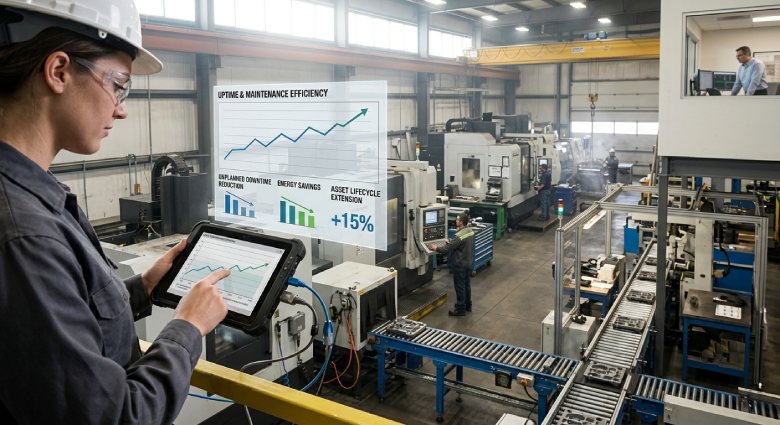
Operational technology reduces such chances by continuously monitoring equipment conditions. It monitors vibration, energy consumption, pressure, and temperature to detect early warning signs. That way, maintenance teams can intervene and fix the problem before it escalates. From a financial perspective, reducing unplanned downtime improves substantial annual savings by:
- Improving equipment reliability
- Increasing productivity
- Lowering emergency repair and maintenance costs
- Reducing revenue loss
Maximizing Asset Utilization for Delayed Capital Spending
Replacing broken industrial equipment is a massive capital investment. Unfortunately, many companies replace their equipment sooner than they should due to poor equipment condition and a lack of timely maintenance.
Operational technology helps businesses maximize the value of their infrastructure. It continuously monitors asset health and helps maintenance teams make data-driven decisions rather than taking a reactive approach. Making timely maintenance decisions helps reduce operational risk and unnecessary capital expenditure. With reduced sudden expenses, financial teams can allocate those funds toward initiatives with greater strategic and financial outcomes.
Lowering Operating Expenses With Smart Maintenance
Traditional maintenance models are mostly reactive, which often leads to emergency inspections, expensive repairs, or replacements. Both approaches can be financially draining and can significantly affect equipment performance.
Operational technology maintains precise control over equipment health through predictive and condition-based maintenance and real-time equipment analysis. All maintenance activities are scheduled based on the asset's current condition, not on a half-yearly or annual basis. Financially, this approach helps organizations:
- Reduce spare parts waste
- Minimize maintenance labor costs
- Prevent critical equipment failures
- Improve accuracy in the maintenance budget
- Optimize maintenance schedules
- Lower the total cost of ownership (TCO) for expensive business assets
Optimizing Energy Consumption for Reduced Utility Expenditure
Understandably, energy costs cover a major portion of enterprise operating expenses, especially in the healthcare, logistics, manufacturing, and commercial sectors. Operational technology continuously monitors water, electricity, HVAC systems, compressed air, and production equipment. Timely monitoring allows maintenance teams and operational leaders to identify inefficiencies, reduce unnecessary energy consumption, and automate processes to bring down utility bills.
Apart from the measurable financial benefits, lowering energy consumption also supports environmental causes and sustainability objectives. For finance teams, the recurring reduction in utility expenses leads directly to improved operating margins and asset efficiency.
Improving Workforce Productivity for Higher Revenue Generation
Even in 2026, labor remains one of the largest sectors where enterprises can control their expenses. The ultimate goal of every organization is to improve workforce efficiency without increasing headcount. And operational technology plays a pivotal role in maximizing labor performance.
Operational technology automates routine monitoring, detailed data collection, and reporting, so employees can focus on higher-value work. While maintenance teams receive immediate updates via real-time alerts, operations managers rely on data to gain insights into equipment performance.
Immediate visibility helps managers identify potential challenges early, reduce overtime, improve technician utilization, and increase output without a drastic increase in labor costs.
Strengthening Financial Decision-Making and Capital Allocation
Financial leaders need reliable data to justify costly investments. Operational technology provides precise information about performance metrics and helps them evaluate whether repairing, replacing, or upgrading equipment would offer a strong financial return. In fact, to maximize enterprise value, leaders can track metrics:
- Equipment uptime
- Capital expenditure avoidance
- Maintenance cost per asset
- Total cost of ownership
- Operating expense reduction
- Energy cost savings
- Mean time between failures
- Overall equipment effectiveness
Tracking these metrics will help finance teams analyze the real impact of operational technology and its return on investment.
Wrapping Up
Operating technology is not just another update to your operational system. It is a strategic investment with measurable financial outcomes. It helps finance teams control costs and maximize ROI.
It does so by reducing downtime and emergency repairs, improving asset utilization, lowering energy costs, and supporting data-driven decisions. For organizations focused on achieving measurable ROI, operational technology can create a practical path to long-term business success

How to Build Links Without Losing Sight of Quality







Why HR Teams Should Connect Workforce Planning With Talent Development